Peak Too Soon: How the Algorithm Killed the Art of the Slow Build
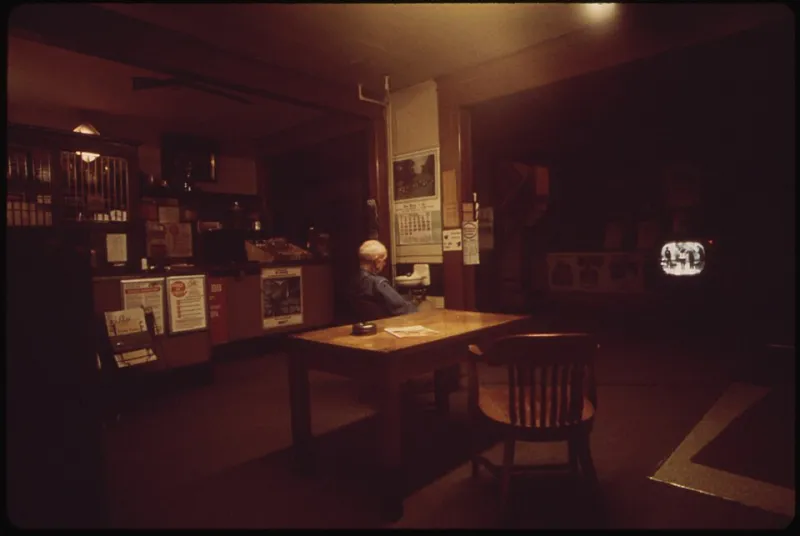
Photo: David Hiser, Public domain, via Wikimedia Commons
There's a specific kind of satisfaction that used to come from a slow-burn TV season. The kind where episode three feels almost boring, episode six makes you nervous, and by episode nine you're canceling plans and ignoring texts. That build—that deliberate, sometimes agonizing accumulation of tension—was a feature, not a bug. It was the whole point.
Now? Most shows spend that energy in the first two episodes. Because they have to. Because if they don't, you're already gone.
The 72-Hour Audition
Streaming platforms don't just track what you watch. They track when you leave. And the data they've collected over the past decade has reshaped how content gets made at a fundamental level. Showrunners aren't just writing for audiences anymore—they're writing for dropout curves.
The unspoken rule in modern prestige TV is simple: hook hard, hook fast, or get canceled before anyone finds out your third act is incredible. Netflix, in particular, has been pretty open about using early viewership data to make renewal decisions. Which means a show that takes four episodes to find its footing—the way Breaking Bad famously did, or The Wire, or Parks and Recreation—would be a serious liability in today's environment.
So writers front-load. They stuff the spectacle, the twists, the emotional gut-punches into the opening episodes. And then, having spent all their ammunition early, they coast. Or they spiral. Or they get canceled anyway, leaving storylines unresolved and fans holding the bag.
Spoiled Before It Starts
It's not just episodic pacing that's taken the hit. Movies have developed their own version of the same problem, and it lives in the marketing department.
The average blockbuster trailer in 2024 is essentially a four-minute highlight reel of the film's best moments. Studios defend this as necessary—you have to compete for attention in a fractured media landscape, and a restrained trailer doesn't trend on X. But the cost is real: by the time most people sit down in the theater, they've already seen the emotional peaks. They know the third-act reveal. They've watched the money shot seventeen times on Instagram.
This isn't just an annoyance. It fundamentally changes how a story lands. Tension requires uncertainty. Surprise requires ignorance. When every significant beat gets pre-distributed through clips and reaction videos and "you need to see this scene" posts, the theatrical experience becomes more like a live performance of something you already have memorized.
And somehow, we keep clicking play on those clips anyway. Because the algorithm rewards the click, not the experience that follows.
What a Slow Burn Actually Does to You
Here's the thing about patience in storytelling: it isn't just a stylistic choice. It's neurologically meaningful.
When a narrative takes its time—when it lets characters breathe, when it builds dread across multiple episodes, when it earns its payoffs through accumulation rather than spectacle—it creates a fundamentally different kind of engagement. You start to care about people rather than events. You develop theories. You feel the weight of consequences because you've had time to understand what's at stake.
Think about what Succession did across four seasons. The first season was polarizing. Rich people being awful to each other, slowly. But the show was building a psychological architecture that made the final season devastating in ways that wouldn't have been possible without all that groundwork. The payoff was proportional to the patience.
Or think about Severance, which takes nearly a full season to fully reveal what kind of show it is—and which works precisely because that slow revelation is the point.
These shows exist in spite of the current environment, not because of it. They're exceptions that prove the rule.
The 15-Second Justification Problem
Social media has introduced a new unit of narrative value: the clip-able moment. Every scene, every line, every emotional beat is now implicitly evaluated on whether it can stand alone in 15 seconds and still communicate something worth sharing.
This has done strange things to dialogue. Watch almost any prestige drama from the last three years and you'll notice how many lines feel written to be screenshots. Punchy, declarative, quotable in isolation. Which sounds fine until you realize that good dialogue isn't supposed to work in isolation—it's supposed to work within a scene, which works within an episode, which works within a season.
When every moment has to justify itself independently, the connective tissue disappears. You get a highlight reel masquerading as a story. You get a show that trends on Twitter every week but somehow feels hollow when you try to remember it six months later.
Is Anyone Building Toward Anything Anymore?
To be fair, the slow burn isn't dead. It's just gotten more expensive to make and harder to sell.
Certain creators have found ways to protect their pacing—usually by front-loading their pitch with enough credentials that studios give them room. Shōgun on FX took its time in ways that felt almost anachronistic in 2024, and it was rewarded with serious critical and audience attention. The Bear trusts its viewers to sit with discomfort. Ripley moved at the pace of a particularly elegant con, because that was the whole aesthetic.
But these shows share something: they all had institutional protection. A network willing to absorb slow early numbers, a creator with enough leverage to resist notes, a marketing team that found ways to sell patience as a feature.
Most shows don't have that. Most shows are working with tighter windows and more aggressive optimization. And the result is a landscape where everything peaks immediately, nothing compounds, and the most common emotional response to finishing a season is "wait, that's it?"
The Audience Didn't Just Lose Patience — They Were Trained Out of It
It's tempting to blame viewers for this. And sure, the data shows that audiences bail early and often. But it's worth remembering that attention spans don't shrink in a vacuum—they're shaped by environment.
A decade of autoplay, skip buttons, and algorithmic feeds optimized for immediate gratification has recalibrated what audiences expect from entertainment. We've been trained to expect the reward upfront, to distrust the slow approach, to interpret a quiet episode as a sign that nothing's happening rather than as evidence that something's being built.
That's not a character flaw. That's conditioning. And the platforms that did the conditioning are now using the results as justification for more of the same.
It's a clean little loop, if you don't think too hard about what it's costing.
The Thing Nobody Wants to Say Out Loud
The algorithm doesn't care about your third act. It doesn't care whether your season finale earns its emotional weight or whether your protagonist's arc actually resolves in a satisfying way. It cares whether you watched episode one all the way through and came back for episode two.
Everything, everywhere, all at once—that's the operating principle. Every moment has to compete with every other moment across every platform simultaneously. There's no such thing as a slow start anymore. There's just the drop-off point, and the scramble to stay above it.
Somewhere in that scramble, we stopped asking whether a story was building toward something. We just started asking whether it was doing something right now.
And honestly? That might be the most important thing we've lost.